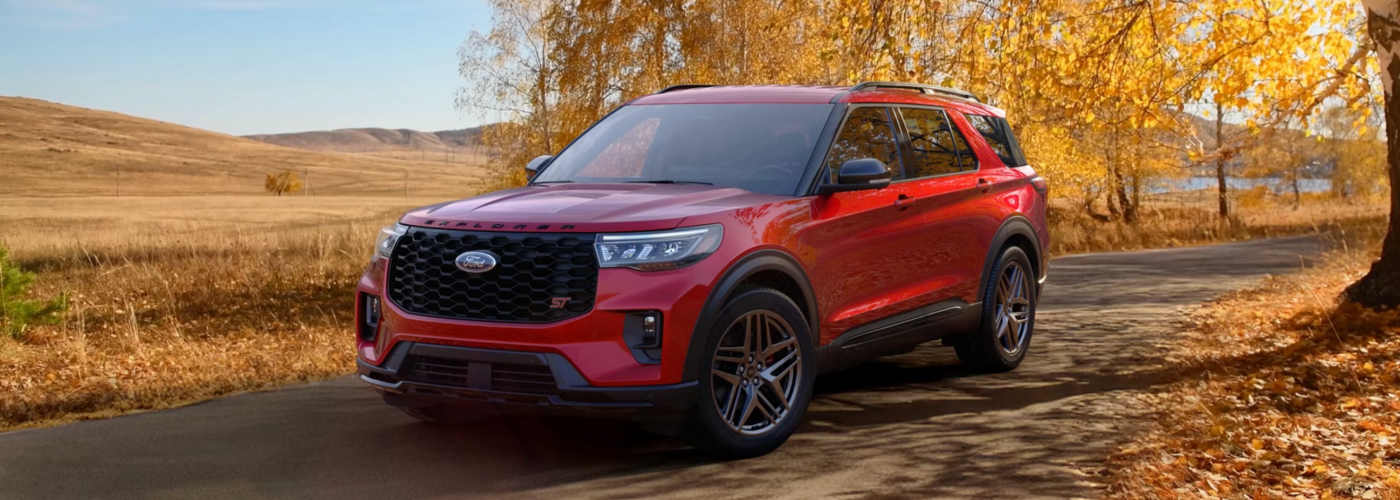
The Ford Explorer lineup includes several trim levels, each aimed at a different kind of driver near Granite City. Some configurations prioritize value and everyday usability, while others add off-road hardware, premium comfort features, or performance-tuned suspension and brakes. Deciding between them comes down to how the SUV will actually be used — commuting around St. Louis, hauling gear for weekend trips, or handling backroads outside Collinsville. For a broader look at what the Explorer offers overall, see the Ford Explorer buyer’s guide. If you’re weighing the Explorer against other three-row SUVs, the Explorer comparisons hub breaks down how it stacks up against the competition.
The Active 100A and Active trims serve as the Explorer’s entry points, built around everyday usability rather than off-road or performance extras. Both come with Ford’s Co-Pilot360® driver-assist suite, which bundles adaptive cruise control and other safety technology as standard equipment. Moving up to the Active trim adds comfort-oriented features like a power-operated liftgate, heated front seats, and available second-row captain’s chairs for easier access to the third row.
For buyers near Edwardsville who mainly use the Explorer for commuting and school runs, these trims cover the core equipment most drivers actually use day to day, without paying for off-road or performance hardware that would go unused. The step from Active 100A to Active is mostly about added comfort and convenience rather than a change in capability.
The Tremor and ST trims move the Explorer in different directions. Tremor adds off-road hardware — a limited-slip rear axle, raised suspension, and underbody protection — for drivers who spend time on unpaved roads or need extra ground clearance. ST instead focuses on street performance, with a sport-tuned suspension, upgraded brakes, and a more powerful available engine option for a sportier feel on paved roads.
Both trims are available with the Explorer’s more powerful engine option, but they apply that power differently — Tremor pairs it with traction-focused hardware, while ST pairs it with handling-focused tuning. Drivers deciding between the two should think about whether their priority is handling rough terrain outside St. Louis or getting a more responsive feel on the highway.
The ST-Line and Platinum trims lean into technology and comfort rather than off-road or track-focused hardware. ST-Line adds sport-styled seating, a 360-degree camera system, and an upgraded sound system, while Platinum brings hands-free highway driving technology, heated and ventilated front seats with massage function, and an available panoramic roof.
These trims suit buyers who want the Explorer’s three-row practicality without giving up daily comfort or convenience technology. Platinum in particular adds driver-assist features that go beyond the standard suite, which can matter for drivers who spend significant time on the highway.
The Active 100A is the standard-equipment starting point, while the Active trim adds comfort features like a power liftgate, heated front seats, and available second-row captain’s chairs.
The Tremor trim is the Explorer’s off-road-focused configuration, adding a limited-slip rear axle, raised suspension, and underbody protection.
Yes, adaptive cruise control is part of the standard Ford Co-Pilot360® suite across the Explorer lineup.
ST is a performance trim with a sport-tuned suspension and upgraded brakes, while ST-Line focuses on styling and technology rather than performance hardware.
Hands-free highway driving technology is available on the Platinum trim.
Weber Ford stocks a range of Explorer trims near Collinsville, so you can compare configurations in person before deciding. Call 618-452-5400 to check current availability or schedule a test drive.